

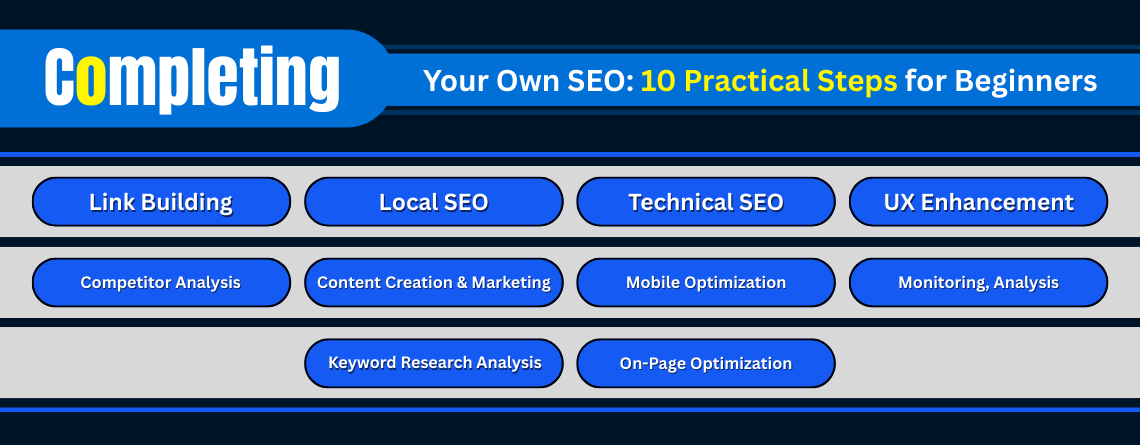
Completing your own SEO means taking control of how your website appears in search engines and improving its visibility without relying entirely on external help. For many website owners and small businesses, this is a practical and achievable approach when done correctly. However, SEO often feels confusing because it involves multiple steps, ongoing optimisation, and understanding how search engines evaluate websites.
This guide breaks down the process into 10 clear, practical steps that show you exactly how to complete your own SEO from start to finish. It explains what actions to take, why each step matters, and how they work together to improve rankings, organic traffic, and overall website performance. Whether you are new to SEO or looking to strengthen your existing efforts, this article provides a straightforward, beginner-friendly roadmap to doing SEO the right way.
Is It Really Possible to Complete Your Own SEO?
Yes, it is absolutely possible to complete your own SEO, provided you understand the fundamentals and are prepared to apply them consistently. DIY SEO works best for small to medium-sized websites, local businesses, and service-based companies that want steady, long-term growth rather than instant results.
However, completing your own SEO requires time, learning, and patience. Search engine optimisation is not a one-off task but an ongoing process. When done correctly, it helps search engines understand your website, trust your content, and rank your pages for relevant searches.
Step 1: Understand How Search Engines Work
Before starting any SEO activity, it is essential to understand how search engines process websites. Search engines such as Google rely on three core processes:
- Crawling – discovering pages through links and sitemaps
- Indexing – storing and organising content in a database
- Ranking – displaying pages based on relevance, quality, and usefulness
SEO exists to make your website easier to crawl, index, and rank. Without this understanding, many DIY SEO efforts focus on the wrong actions and deliver poor results. Knowing how search engines work allows you to prioritise tasks that actually impact visibility.
Step 2: Carry Out Keyword Research for DIY SEO
Keyword research is the foundation of completing your own SEO. Keywords tell you what users are searching for and how they phrase their questions.
Effective keyword research involves identifying terms that are:
- Relevant to your business
- Realistically achievable
- Aligned with user intent
Focus on a mix of short and long-tail keywords. Long-tail keywords are especially valuable for DIY SEO because they are more specific and usually less competitive. Instead of targeting broad terms, aim for keywords that match real problems and questions your audience is searching for.
Avoid keyword stuffing. Keywords should appear naturally in your content, headings, and metadata, not forced into every sentence.

Step 3: Optimise Individual Pages with On-Page SEO
On-page SEO ensures that each page on your website clearly communicates its topic to search engines. This step is critical when completing your own SEO, as it directly affects rankings.
Key on-page elements include:
- Page titles that accurately describe the content
- Meta descriptions that encourage clicks
- Proper heading structure (H1, H2, H3)
- Clear internal linking between related pages
Each page should focus on one main topic rather than trying to rank for everything at once. Well-optimised pages are easier for search engines to understand and more useful for users.
Step 4: Create Helpful, Search-Focused Content
Content quality plays a major role in SEO performance. Search engines prioritise pages that fully answer user questions and provide genuine value.
When creating content as part of your DIY SEO strategy, focus on:
- Addressing search intent clearly
- Explaining topics in plain language
- Covering the subject thoroughly
- Updating outdated information regularly
Thin or generic content rarely performs well. Instead, aim to create pages that demonstrate real understanding and experience. High-quality content builds trust with both users and search engines, improving long-term rankings.
Step 5: Fix Technical SEO Issues
Technical SEO ensures that your website functions properly and can be accessed by search engines without issues. Many ranking problems stem from technical errors rather than content quality.
Important technical factors include:
- Fast page loading speeds
- Mobile-friendly design
- Secure HTTPS connection
- Proper indexing and crawlability
- Fixing broken links and errors
Completing your own SEO means addressing these basics to prevent technical issues from holding your site back. Even small improvements in performance and usability can have a positive impact on rankings.
Step 6: Improve Website User Experience
User experience is closely tied to SEO success. Search engines increasingly evaluate how users interact with your site, including time on page, navigation, and readability.
Improving user experience involves:
- Clear site structure
- Easy navigation
- Logical content layout
- Readable formatting
A website that is easy to use keeps visitors engaged longer, which sends positive signals to search engines. When users can quickly find what they need, your SEO efforts are far more effective.
Step 7: Build a Strong Internal Linking Structure
Internal linking helps search engines understand the relationship between pages on your website. It also helps distribute authority and guide users to relevant content.
Effective internal linking:
- Connects related topics naturally
- Uses descriptive anchor text
- Supports important pages
- Improves crawlability
When completing your own SEO, internal linking is often overlooked, yet it plays a significant role in boosting page performance. A well-structured site helps search engines recognise topical relevance and authority.
Step 8: Track SEO Performance and Progress
SEO results take time, so tracking progress is essential. Monitoring performance helps you understand what is working and what needs improvement.
Key metrics to track include:
- Organic traffic growth
- Keyword rankings
- Page engagement
- Indexing status
DIY SEO requires regular review and adjustment. Search trends change, competitors evolve, and algorithms update. Tracking ensures your strategy remains aligned with current performance and goals.

Step 9: Avoid Common DIY SEO Mistakes
Many people struggle with completing their own SEO because of avoidable mistakes. Understanding these pitfalls can save time and prevent ranking issues.
Common DIY SEO mistakes include:
- Overusing keywords unnaturally
- Ignoring technical problems
- Publishing low-quality content
- Expecting instant results
- Failing to update existing pages
SEO is a long-term strategy. Avoid shortcuts and focus on building sustainable improvements that deliver consistent results.
Step 10: Know When to Stop Doing SEO Yourself
While completing your own SEO is achievable, there comes a point where professional support becomes beneficial. This is especially true for competitive industries, large websites, or businesses that rely heavily on organic traffic.
Signs that DIY SEO may no longer be enough include:
- Limited time to manage SEO properly
- Technical issues beyond basic fixes
- Stagnant rankings despite consistent effort
- Increased competition in search results
At this stage, professional SEO support can help scale results, address advanced challenges, and prevent costly mistakes.
Frequently Asked Questions About Completing Your Own SEO
How long does it take to see SEO results?
SEO typically takes several months to show noticeable improvements. Consistent effort and patience are essential.
Is DIY SEO worth it for small businesses?
Yes, DIY SEO is highly effective for small businesses when done correctly, especially for local and niche markets.
Do I need paid SEO tools?
Paid tools can help, but many SEO tasks can be completed using free tools and manual analysis.
Can SEO be done without technical knowledge?
Basic SEO does not require advanced technical skills, but some technical understanding is helpful for troubleshooting issues.
Conclusion: Completing Your Own SEO Successfully
Completing your own SEO is a practical and achievable goal when approached methodically. By understanding how search engines work, targeting the right keywords, creating valuable content, fixing technical issues, and tracking performance, you can significantly improve your website’s visibility.
DIY SEO is not about shortcuts or trends; it is about consistency, clarity, and quality. When these elements come together, your website becomes easier to find, more useful to users, and better positioned for long-term organic growth.





Leave a Reply